
Desktop Power Supply for OEM Equipment
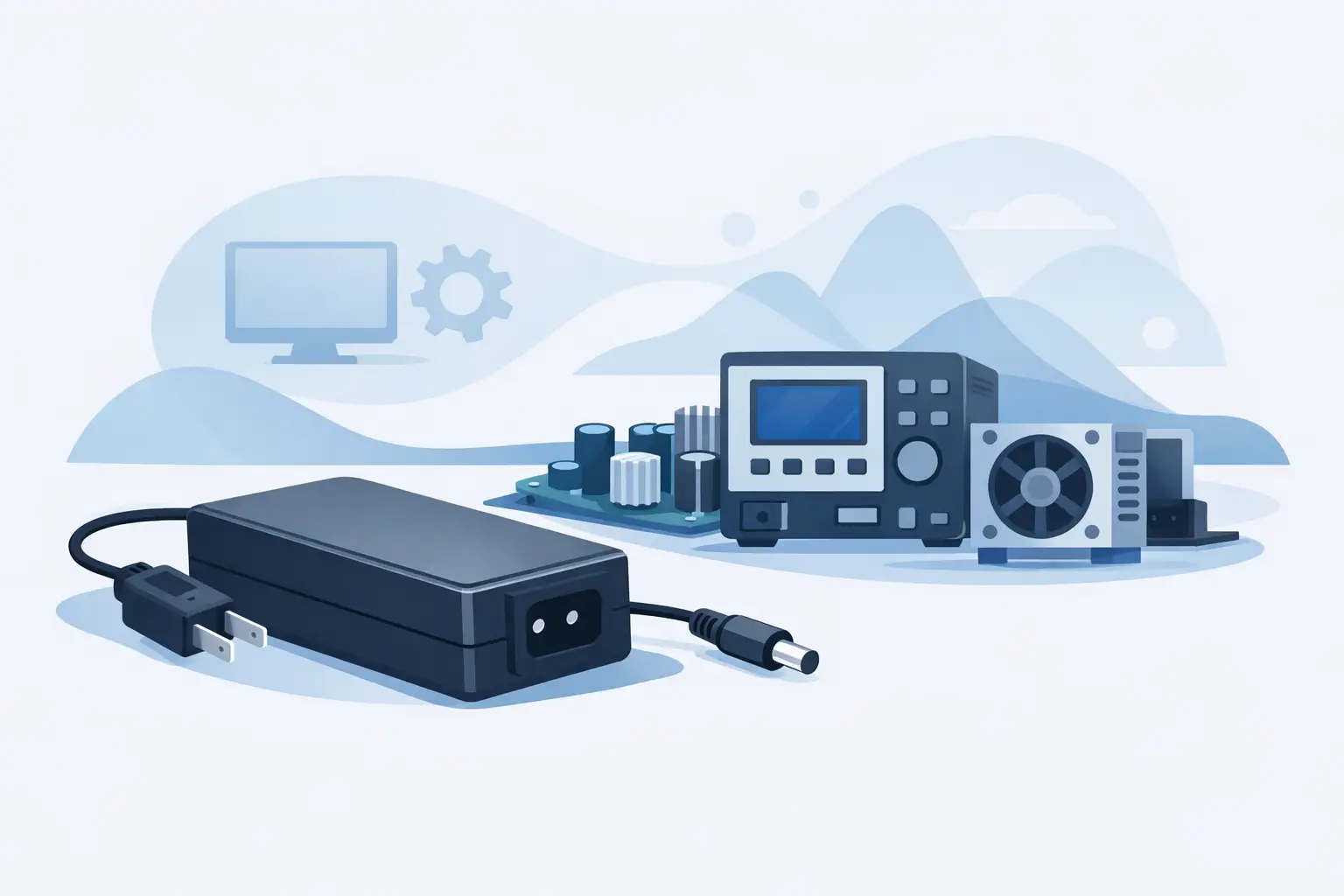
When a product ships with the wrong external power unit, the problem rarely stays isolated to the power brick. It becomes a field failure, a service call, a compliance question, or a production delay. That is why selecting a desktop power supply for OEM equipment deserves the same discipline as any other critical component in the design.
For OEMs and ODMs, the desktop supply is not just an accessory. It is part of the total power path, part of the user experience, and often part of the product’s certification strategy. In medical, industrial, communications, and commercial equipment, a mismatch in voltage, connector geometry, leakage limits, or regional input requirements can create expensive downstream issues.
What a desktop power supply for OEM equipment needs to do
A desktop power supply for OEM equipment typically sits outside the enclosure, converts AC mains to the required DC output, and connects to the device through a low-voltage cord and plug. That sounds straightforward, but the specification work behind it is rarely simple.
The first job is electrical compatibility. Output voltage has to match the equipment requirement within the allowed tolerance. Current rating must support continuous load, startup behavior, and any peak demand the product creates during operation. A supply that works on a bench at nominal load may still fail in production if the real application includes motors, communications modules, heaters, displays, or charging functions that change demand over time.
The second job is environmental and operational fit. Some equipment runs in climate-controlled offices. Some is installed in manufacturing cells, labs, kitchens, carts, or service bays. The power supply has to hold up under the expected duty cycle, cable handling, temperature range, and mounting reality. Desktop supplies are often chosen because they keep heat and mains wiring outside the host equipment, but that only helps if the adapter itself is suited to the installation.
The third job is compliance alignment. Depending on the end market, the power unit may need to support energy efficiency, safety, EMC, and application-specific approval requirements. That is where many sourcing decisions become more complicated than a simple voltage-and-amperage match.
Start with the load, not the catalog
Engineering and purchasing teams often review desktop supplies by output class first – 12V, 24V, 48V, 60W, 120W, and so on. That is useful, but it should not be the starting point. The better approach is to define how the equipment actually behaves.
A device with a stable electronics load is easier to support than one with variable draw, inrush current, inductive elements, or intermittent high-demand modes. If the product includes printers, actuators, LED lighting arrays, pumps, or communication bursts, the adapter may need more margin than the steady-state number suggests. Undersizing usually does not fail gracefully. It can show up as thermal stress, nuisance shutdowns, shortened life, or erratic performance that is difficult to diagnose in the field.
There is also the question of duty cycle. A desktop unit powering a point-of-sale terminal all day has different stress patterns than one used for occasional bench instrumentation. Continuous-use applications generally benefit from conservative derating and attention to thermal performance.
Electrical specs that matter more than buyers expect
Voltage and current get most of the attention, but they are not the whole story. Output regulation, ripple, hold-up behavior, startup timing, and protection features all affect whether the supply is a good fit.
Sensitive electronics may require tighter output regulation and lower ripple noise. Embedded computing platforms, communications hardware, and measurement equipment can be more affected by output quality than simpler loads. On the other hand, some equipment includes its own internal regulation and can tolerate a wider range, which may expand sourcing options.
Protection functions matter because real-world use is messy. Short-circuit, over-current, over-voltage, and thermal protection are not just checkbox features. They help limit damage when cables are pinched, connectors are misapplied, or the load behaves unexpectedly. The trade-off is that protection behavior differs by design. Some units hiccup and recover automatically. Others latch off until power is recycled. That difference can matter a lot in unattended equipment.
Power factor correction and efficiency may also enter the picture, especially in higher wattage designs or regulated markets. These are not just compliance concerns. Better efficiency can reduce heat and improve long-term reliability.
Connector fit is often where field problems begin
A desktop supply can be electrically correct and still fail as an OEM choice if the DC connector is wrong for the application. Barrel size, center pin configuration, polarity, retention, strain relief, and cable length all affect usability and service outcomes.
Loose-fitting connectors create intermittent power loss that looks like an equipment defect. Reversed polarity can damage the product immediately. A cord that is too short invites extension workarounds. A cord that is too long can clutter an installation or create handling issues in compact workspaces.
This is one reason specification-driven sourcing matters. The adapter and the cord set should be treated as part of a complete assembly, not as separate afterthoughts. In some programs, custom connector termination or cord length is the difference between a workable standard part and a cleaner production solution.
Compliance is application-specific
Not every OEM program needs the same approvals, and assuming that any listed desktop supply will work can create delays late in the process. Safety requirements vary by product category, sales geography, installation environment, and end-use market.
Medical-related equipment may involve stricter leakage and approval considerations. Industrial and commercial systems may have specific EMC expectations. Products shipping internationally may need broader input compatibility and market-specific certifications. Even within the US, buyer requirements can differ by customer account, installation site, or insurance and inspection standards.
This is where experienced sourcing support saves time. The right question is not simply whether the adapter is approved. It is whether the approval profile supports the intended equipment and channel strategy.
Standard versus custom sourcing
For many OEMs, a standard desktop power supply is the best answer. If the electrical output, connector, approvals, and cord configuration align with the application, a standard platform can reduce cost, shorten qualification time, and simplify replenishment.
But standard does not always mean suitable. If your product has unusual connector requirements, branding needs, cable preferences, regional input combinations, or specific mechanical constraints, a custom or semi-custom sourcing path may be more practical. That does not always mean a fully bespoke design. Sometimes it means modifying the output cord, changing a plug style, or matching a regional power cord requirement more precisely.
The trade-off is time and complexity. Customization can improve product fit and reduce field issues, but it may involve higher minimums, longer qualification cycles, and more documentation review. For stable, long-run OEM programs, that trade often makes sense. For lower-volume or rapidly changing products, a proven standard option may be the smarter business choice.
Supply continuity matters as much as unit price
Procurement teams already know this, but it bears repeating: the cheapest qualified adapter is not always the lowest-cost sourcing decision. Desktop power supplies affect production schedules, service inventory, and customer support exposure.
If a part is difficult to replenish, subject to frequent revision, or tied to a narrow source, the risk can outweigh the savings. Consistent availability, document control, sample support, and responsiveness during qualification all matter. So does the ability to support domestic and international cord requirements when the same equipment platform serves multiple markets.
A dependable supplier relationship is especially important when a power component sits inside a broader launch schedule. Engineering may need evaluation samples. Purchasing may need alternate sourcing paths. Operations may need confidence that the approved unit will remain available across the production horizon. Companies such as High Tech Connections support that process by combining product specialization with sourcing and application support that fits OEM workflows.
Questions worth settling early
The best desktop power supply selections are usually made before the project reaches a deadline. Early review helps teams avoid redesigns and rushed substitutions.
At minimum, teams should align on actual load behavior, required output tolerances, connector details, installation environment, regional input needs, approval requirements, and expected production volumes. It is also worth confirming whether future product variants might share the same supply platform. Standardization across a family of products can reduce inventory complexity, but only if the common supply truly fits all use cases.
That last point is where experience helps. A power unit that is acceptable for one model may be marginal for another, even when the nameplate ratings look close.
A desktop power supply for OEM equipment should be chosen the way other critical components are chosen – by application fit, not by convenience. The right selection supports product reliability, smoother production, and fewer surprises after installation. When the power source is specified with that level of care, it stops being a sourcing problem and becomes one less thing your team has to revisit later.
Leave a Comment