
AC Adapter vs Power Supply: What Changes?
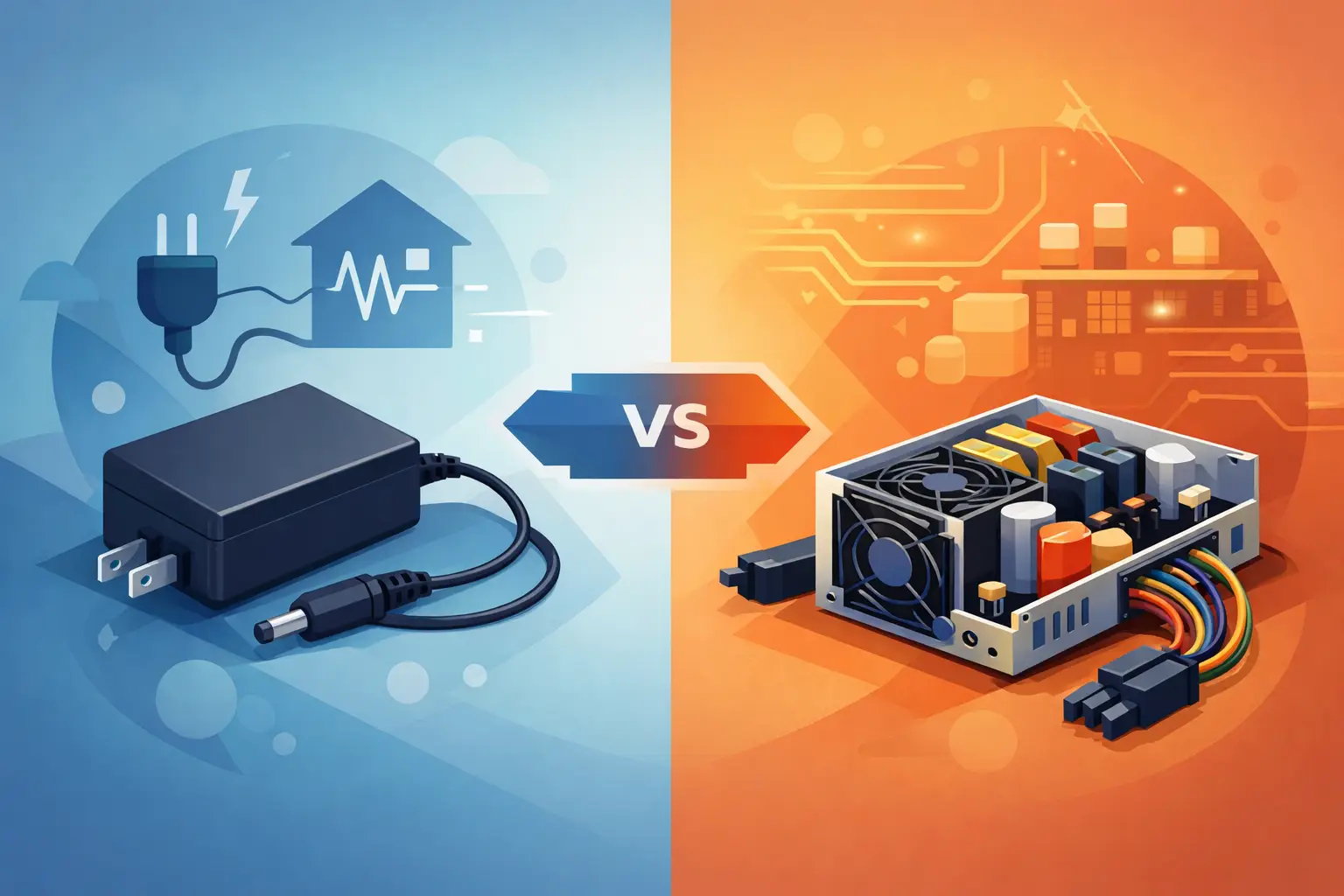
A spec sheet says power supply. The mechanical drawing says adapter. Purchasing calls it a charger. That kind of mismatch causes delays fast, especially when an engineering team is trying to qualify a replacement or source a production part. In practical terms, the ac adapter vs power supply question matters because those labels are often used loosely, while the electrical, mechanical, and regulatory requirements are not.
For OEMs, ODMs, and industrial buyers, the right choice depends less on the name and more on how the unit converts power, where it is installed, what output it delivers, and what approvals the finished equipment requires. If those details are missed early, the result can be rework, field failures, or a sourcing problem late in the build cycle.
AC adapter vs power supply: the basic difference
At a broad level, a power supply is the larger category. It is any device or circuit that takes incoming electrical power and converts it into the voltage and current a load needs. That can include open-frame supplies, enclosed industrial units, internal board-level supplies, desktop external supplies, and wall-mount adapters.
An AC adapter is usually a type of external power supply. In most cases, it plugs into an AC outlet and converts AC line power into a lower DC output for the equipment. Many adapters are used with IT equipment, communications devices, lab instruments, small appliances, lighting products, and other electronic systems where keeping the conversion electronics outside the main enclosure is helpful.
So the cleanest way to frame it is this: every AC adapter is a power supply, but not every power supply is an AC adapter.
That sounds straightforward, but sourcing decisions get more complicated once you move beyond naming and into application requirements.
Where terminology creates confusion
In day-to-day buying, the terms are often used interchangeably. A desktop brick may be called an adapter, a power supply, an external PSU, or even a transformer, even though transformer is not technically accurate for most modern switch-mode units. A wall plug unit may be called an AC adapter even when the output is DC. In some markets, users also call any external unit a charger, even if the charging circuit is actually inside the end product.
For engineering and procurement teams, that loose language is risky because it can hide differences in output type, connector configuration, enclosure style, and approvals. If a request for quote only asks for a power supply, that leaves too much open. Is the unit external or internal? Does it need a fixed blade wall plug or an IEC inlet? Is the output regulated? What barrel size, polarity, or locking connector is required? Does the application require medical, industrial, or IT safety compliance?
Those are the details that define fit.
Form factor often decides the right choice
One of the most practical differences in the ac adapter vs power supply discussion is physical format.
An AC adapter is typically external. It may be a wall-mount unit that plugs directly into a receptacle or a desktop supply with a detachable AC cord on the input side and a DC output cord on the load side. External designs help move heat outside the product enclosure, reduce internal design complexity, and simplify service replacement.
A power supply, used in the broader sense, may be internal to the equipment. That could be an enclosed chassis-mount supply in a machine, an open-frame supply inside food service equipment, or a board-mounted unit in communications hardware. Internal supplies make sense when the product needs a compact integrated design, higher output power, multiple rails, or application-specific thermal management.
Neither approach is inherently better. External adapters can be easier to source and replace, but they add cable management and may be less desirable for heavy-duty fixed installations. Internal power supplies support tighter product integration, but they place more responsibility on the equipment design for cooling, enclosure access, and safety considerations.
Output matters more than the label
Many buyers start with the name of the product, but the output specification is what actually determines compatibility.
Most AC adapters convert 100 to 240V AC input into a single DC output such as 5V, 12V, 24V, or 48V. They are commonly regulated, meaning the output stays within a defined range as load conditions change. That stability matters for electronics that are sensitive to voltage fluctuation.
Power supplies as a category can do much more. Some convert AC to DC. Others convert DC to DC. Some provide a single output, while others offer multiple output rails. Industrial supplies may support higher power levels, remote sensing, power factor correction, or specific hold-up time requirements. Depending on the application, you may need tighter ripple and noise performance, inrush current control, or protection features such as overvoltage, overcurrent, and short-circuit shutdown.
This is where substitution mistakes happen. Two units may both be called 24V power supplies, but if one is lightly regulated and the other is tightly regulated, or if one is rated for intermittent duty and the other for continuous operation, they are not equivalent in service.
Compliance and end-market requirements change the answer
In consumer applications, a generic replacement may sometimes be enough. In commercial and industrial equipment, that is rarely the right standard.
The correct source depends on where the equipment is used and what standards apply to the finished product. Medical devices, laboratory equipment, food service systems, communications hardware, and industrial controls can each bring different compliance expectations. Safety approvals, efficiency levels, insulation class, leakage current, and environmental ratings all need to align with the use case.
External AC adapters can simplify approvals in some product designs because the hazardous AC conversion stage is outside the main equipment enclosure. That said, the adapter itself still needs the right agency approvals and construction quality. An internal power supply may better support a specialized system, but it can also shift more certification and thermal validation work into the overall equipment design.
There is also the issue of regional deployment. If a product ships globally, input range, detachable cord sets, plug configuration, and country-specific certifications become part of the sourcing decision. That is one reason many OEMs standardize around universal input external supplies for some product lines, while using integrated internal supplies for others.
Sourcing considerations for OEMs and purchasing teams
When buyers compare an AC adapter to a power supply, the operational question is usually not which term is correct. It is which option reduces risk across production, installation, and service.
External adapters can offer advantages when field replacement matters. If a unit fails, service can often swap the external supply without opening the equipment. They can also help shorten development time when a standard, approved solution fits the load and connector requirements.
Internal power supplies may make more sense when the product needs higher wattage, multiple outputs, a cleaner installed appearance, or a controlled internal power architecture. They can also reduce dependency on a separate external brick in environments where cable strain, tampering, or connector disconnection is a concern.
Lead times and second-source strategy matter too. A design that depends on a very specific external adapter housing or uncommon connector may become difficult to support over the long term. Likewise, an internal supply with custom mounting and output characteristics may lock the product into a narrow sourcing path. The best choice is often the one that meets the electrical requirement while preserving practical options for procurement and future replacement.
How to evaluate the right option
For most equipment programs, the decision comes down to a short set of specification questions. Start with input and output requirements, then confirm power rating, regulation, connector type, duty cycle, approvals, and environmental conditions. After that, look at mechanical integration. Does the product benefit from keeping conversion external, or is an internal supply the better fit for packaging and performance?
It also helps to define whether the need is standard or custom. If a standard desktop adapter can meet the load, connector, and compliance targets, that can simplify sourcing. If the product has unusual cable lengths, locking connectors, country-specific cord requirements, or mechanical constraints, a more tailored power solution may be necessary.
This is where an experienced supply partner can help narrow the field before engineering time is wasted on the wrong format. High Tech Connections supports buyers who need that kind of specification-based guidance, especially when cord sets, adapters, and related connectivity components must work together as part of the finished product.
The real takeaway on AC adapter vs power supply
If you are choosing between the two, start by treating power supply as the functional category and AC adapter as one possible form within it. Then focus on the requirements that actually affect product performance: input range, output type, regulation, wattage, connector system, approvals, serviceability, and long-term sourcing.
That approach usually leads to a better decision than relying on terminology alone. Names can be flexible. Electrical requirements are not.
When the application is clear, the right format becomes clearer too – and that is what keeps specification, purchasing, and production moving in the same direction.
Leave a Comment