
Why Do Medical Devices Need Certified Cords?
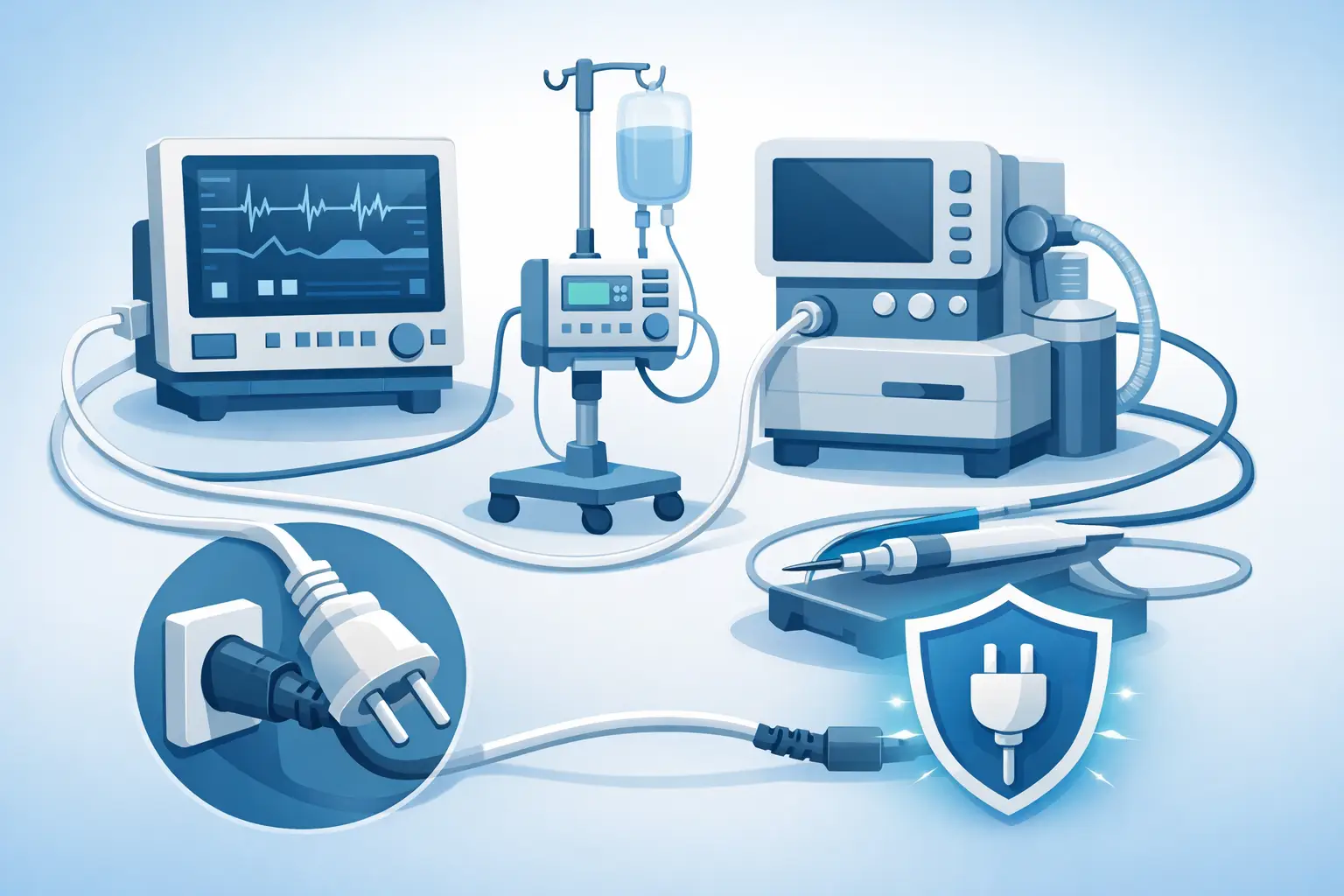

A power cord can hold up an entire medical device launch. That may sound disproportionate until a test lab flags the cord set, a hospital buyer asks for proof of approvals, or a field issue traces back to heat, strain, or grounding performance. When engineers and sourcing teams ask why do medical devices need certified cords, the short answer is simple: the cord is part of the safety system, not just an accessory.
In medical applications, the power path has to do more than deliver electricity. It has to support patient safety, operator safety, regulatory review, and long-term equipment reliability. That applies whether the device is used in a hospital room, a laboratory, a dental office, or an outpatient clinic. A certified cord helps verify that the assembly has been evaluated for the environment and use case it is entering.
Why do medical devices need certified cords in the first place?
Medical equipment operates in conditions where failure carries more risk than inconvenience. If a consumer device loses power, the result may be frustration. If a diagnostic, monitoring, or treatment device loses power, overheats, or develops a grounding problem, the consequences can be more serious.
Certified cords matter because they provide documented evidence that the cord set meets defined electrical and mechanical requirements. That can include conductor sizing, insulation integrity, grounding continuity, plug and connector construction, flammability characteristics, and strain relief performance. Certification does not guarantee that every application is safe by default, but it shows that the cord has been evaluated to recognized standards rather than selected on appearance or nominal fit alone.
For OEMs and ODMs, that distinction matters early in development and later in production. During design, a certified cord helps reduce uncertainty around approvals and performance. During procurement, it helps create a repeatable specification that purchasing teams can source against without introducing unnecessary compliance risk.
Certification supports both safety and market access
One common mistake is treating certification as a paperwork exercise. In reality, it affects both engineering outcomes and commercial outcomes.
On the engineering side, certified cords support core safety expectations. A medical device may be used near patients, cleaned frequently, moved between rooms, or plugged and unplugged many times each day. The cord needs to tolerate normal wear without exposing conductors, losing grounding integrity, or creating heat at the connection points. A certified product has been reviewed against established criteria for those kinds of risks.
On the commercial side, many customers, testing bodies, and regulatory pathways expect approved power components. If the finished device is going through evaluation, uncertified or poorly documented cordage can slow the process. Even when a cord seems technically adequate, the lack of recognized approvals can trigger additional questions, substitutions, or retesting. That means delays, added cost, and sourcing disruption.
This is one reason experienced medical equipment teams specify the cord set early instead of leaving it for the end of the build. The last component chosen can become the last component approved.
Certified cords are part of the total device compliance picture
A certified cord does not replace full device evaluation. The overall medical product still has to meet the standards and requirements relevant to its classification, function, and market. But the cord is part of that larger compliance picture.
Think about the cord as one of the few parts of the device that connects your equipment directly to the facility power source and is handled constantly by users. That combination makes it visible in testing and vulnerable in real-world use. If the cord set has inconsistent construction, poor retention, weak jacket material, or undocumented components, it can undermine confidence in the whole product.
This is also where specification discipline matters. It is not enough for a cord to be certified in a general sense. The exact configuration matters: plug type, wire gauge, jacket material, length, shielding if applicable, connector style, temperature rating, and region-specific approvals. Substituting one “equivalent” cord for another without reviewing these details can create compliance gaps.
Why do medical devices need certified cords for reliability, not just safety?
Safety usually drives the conversation, but reliability is just as important for medical equipment manufacturers and buyers. A cord that passes power under ideal conditions may still fail too early in the field if it is not built for the actual application.
Medical devices often face rolling loads, repeated flexing, chemical exposure from cleaning agents, and storage in tight spaces. Portable carts, imaging support devices, lab analyzers, and treatment equipment all put different stresses on the cord and cord set. A certified cord is not automatically the right cord, but certification narrows the field to products with validated construction and gives engineers a better starting point.
Reliability also has a direct cost impact. Early cord failures increase service calls, replacements, warranty claims, and customer dissatisfaction. In institutional environments, a failed cord can take equipment out of service and create administrative issues for maintenance teams. For OEMs, those downstream costs usually outweigh the small savings gained by sourcing a lower-grade assembly.
That is why many buyers look beyond unit price and ask more practical questions. Is the cord approved for the market where the equipment will be sold? Is the jacket suitable for the cleaning environment? Is the strain relief appropriate for repeated handling? Can the supplier maintain consistency across production runs? Those are sourcing questions, but they are also quality questions.
Not every medical device needs the same cord strategy
This is where the answer becomes more nuanced. The certification and cord construction needed for one medical product may not be right for another.
A stationary lab instrument used in a controlled indoor setting may have different cord requirements than a portable patient-area device that is moved constantly and cleaned multiple times per shift. Equipment intended for domestic and international distribution may require broader approval coverage and market-specific plug configurations. Devices sold into one region with limited environmental exposure may allow a narrower cord specification.
There is also a difference between using a cord on equipment adjacent to patient care and using one on less critical support equipment. The end-use environment, applicable standards, current draw, and mechanical demands all influence the selection. That is why a generic “hospital-grade” label alone does not resolve the engineering decision. It may be part of the requirement, but the full cord set still has to match the device and the market.
Sourcing risks increase when certification is treated casually
From a procurement perspective, certified cords help reduce substitution risk. In regulated and performance-critical markets, an undocumented component change can create headaches across engineering, quality, and operations.
If a supplier cannot clearly identify approvals, materials, test data, and configuration details, buyers may end up spending additional time validating incoming product or dealing with inconsistencies after release. Small changes in plug molding, conductor strand count, jacket compound, or connector sourcing can affect fit, durability, and approval status. Those changes are not always obvious at receiving inspection.
Working with a specification-driven supplier helps control that risk. It gives purchasing teams better visibility into what is being ordered and gives engineering teams more confidence that the approved configuration is the one that will ship repeatedly. For companies managing production schedules, that consistency is often as valuable as the component itself.
What buyers and engineers should verify
When reviewing medical device cord options, the practical question is not simply whether the cord is certified. The better question is whether the certification, construction, and documentation align with the intended use.
That means confirming the applicable approvals, electrical ratings, plug and connector compatibility, conductor size, jacket material, strain relief design, and any market-specific requirements. It also means reviewing how the cord will actually be used. Will it be dragged, bent sharply, cleaned aggressively, or connected in a tight panel layout? Will it ship globally? Will it need a custom length or unique termination?
These details are where many projects either move smoothly or stall. A qualified supply partner can help identify mismatches before they become approval delays or field failures. For manufacturers serving medical and other regulated equipment markets, that practical support is often the difference between buying a cord and sourcing the right cord.
High Tech Connections works with OEMs, engineering teams, and industrial buyers that need this kind of specification-focused support across power cords and related connectivity components.
Certified cords are not about checking a box. They are about protecting the performance, approval path, and dependability of the equipment attached to them. In medical devices, that is reason enough to treat the cord as a critical component from the start, not a commodity at the end.
Leave a Comment