
Choosing an OEM Cord Set Manufacturer
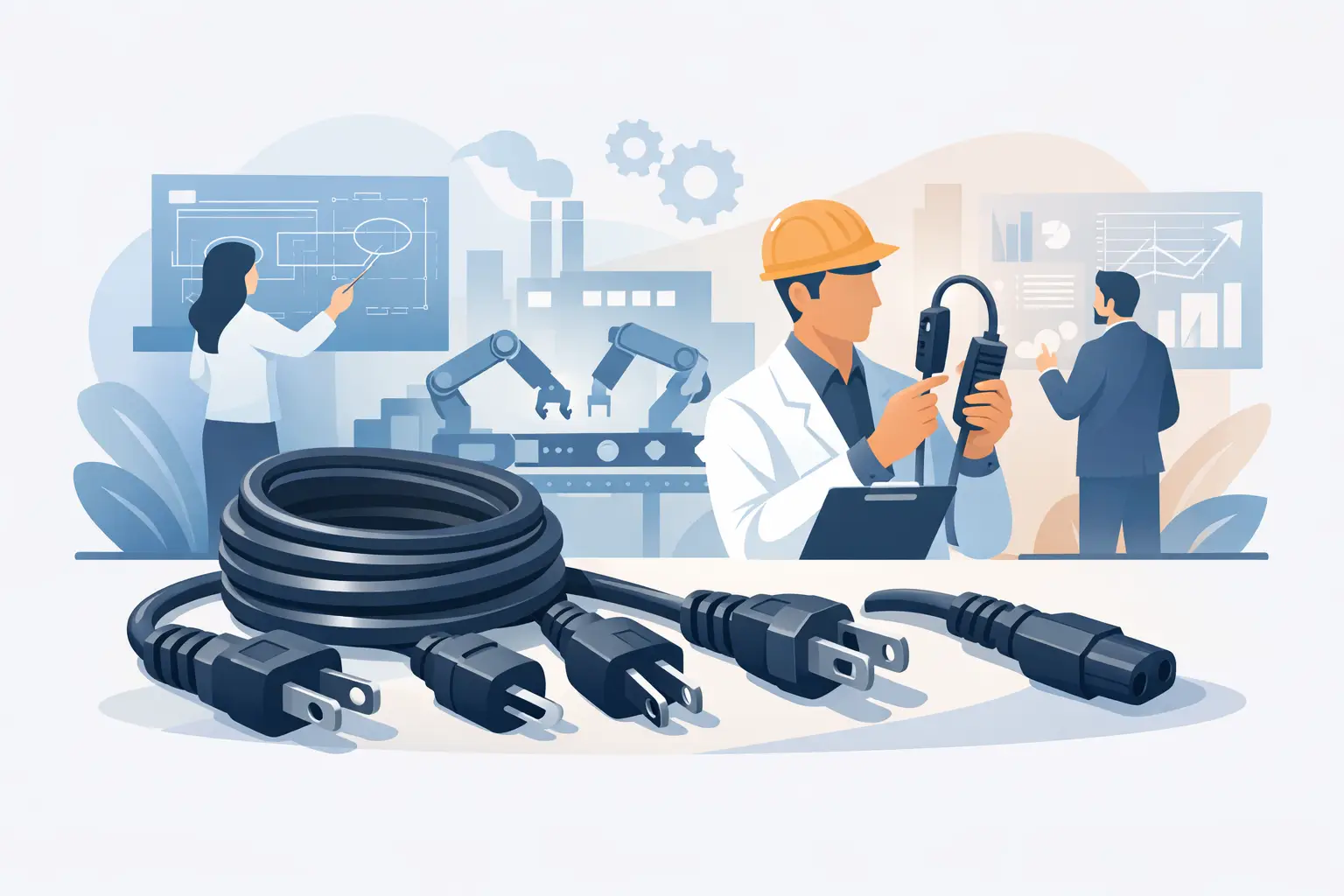
A cord set issue usually shows up late – after the enclosure is approved, the power entry is fixed, and production is close enough that any change becomes expensive. That is why choosing an OEM cord set manufacturer is rarely just a purchasing task. It affects product compliance, field reliability, and whether your build schedule stays intact when demand shifts.
For equipment makers, the cord set is not a commodity in the casual sense. It has to match the electrical load, the installation environment, the market of use, and the regulatory path of the finished product. If the supplier does not understand that, small mismatches turn into larger problems: labeling conflicts, plug incompatibility, jacket performance issues, missing approvals, or inconsistent availability across production runs.
What an OEM cord set manufacturer should actually provide
At a minimum, a qualified supplier should do more than quote a part number and a lead time. For OEM and ODM programs, the job is to align cord set selection with the realities of the finished equipment. That includes current and voltage requirements, attachment plug and connector configuration, conductor size, jacket material, flex needs, temperature rating, agency approvals, and any regional requirements tied to where the equipment will be installed or sold.
That sounds straightforward until a product line branches into multiple SKUs or countries. A server, food service unit, lab instrument, or powered workstation may share a common platform while requiring different country-specific plugs, different cord lengths, or different retention needs. In those cases, the value of an experienced supplier is not just product access. It is the ability to keep the specification disciplined while managing variations without creating unnecessary sourcing complexity.
A practical OEM cord set manufacturer also understands where standard products work well and where customization is justified. Custom is not always the better answer. If a standard approved configuration meets the requirement, it can reduce cost and improve replenishment flexibility. But when the application calls for a non-standard length, specific color, special stripping, locking interface, retractile construction, or unique packaging for production use, the supplier should be able to support that discussion without forcing a one-size-fits-all catalog answer.
How to evaluate an OEM cord set manufacturer
The strongest evaluations usually start with application fit rather than price. Unit cost matters, but the lower-cost option loses value quickly if it creates requalification work, delays, or field failures.
Specification discipline matters early
An effective supplier asks detailed questions before recommending a cord set. They should want to know the end equipment type, power inlet or termination style, operating environment, bend and flex expectations, approval needs, and forecast assumptions. If those questions never come up, that is a warning sign.
Engineering teams typically need confidence that the offered product matches the actual use case, not a broad category description. Procurement teams need confidence that the quoted item can be sourced consistently and documented properly. A good supplier supports both needs with clear specifications, sample availability, and realistic communication about alternatives when a requested configuration is not the best fit.
Compliance is not just a checkbox
Cord sets often sit inside a broader approval framework for the finished product. That means regulatory alignment should be treated carefully from the start. The right supplier should be comfortable discussing agency marks, regional plug standards, applicable ratings, and how a selected cord set supports the intended market.
This is especially relevant in regulated or performance-sensitive sectors such as medical support equipment, commercial appliances, laboratory instruments, and industrial systems. In those environments, a substitute part that looks equivalent may not actually be equivalent from a documentation or approval standpoint. An OEM cord set manufacturer should be able to help prevent that kind of mismatch before it reaches the production floor.
Supply continuity is part of the product
For many buyers, the real test of a supplier comes after the first order. Can they support repeat production? Can they help when demand increases unexpectedly? Can they offer alternate sourcing paths if one region faces constraints?
This is where supplier depth matters. A source with access to both domestic and international cord offerings can often provide more options when timelines tighten or when a program needs multiple market-specific variants. That does not mean every alternative is interchangeable. It means the supplier can guide the trade-offs between lead time, origin, approvals, and cost with a clearer understanding of production realities.
Standard versus custom cord sets
This is one of the most common decision points for OEM buyers. Standard cord sets typically offer faster availability, simpler qualification, and lower setup cost. They are often the right choice when the application fits established ratings and common plug and connector combinations.
Custom cord sets make sense when the equipment design or installation demands something more specific. That may include a unique overall length, stripped and terminated ends, non-standard color coding, coiled or retractile construction, higher flex performance, or packaging tailored for assembly operations. In some programs, custom also helps reduce installation errors by making the part physically distinct from other power components used in the same build environment.
The trade-off is that custom parts usually require more upfront review and may carry higher minimums or longer qualification timelines. That is not a reason to avoid them. It is simply a reason to use them deliberately. The right supplier helps determine whether the custom feature solves a real manufacturing or performance problem, or whether a standard approved cord set would do the job with less complexity.
Where OEM cord set sourcing often goes wrong
The most common problems are rarely dramatic at first. A cord length gets specified from a prototype layout rather than the actual installed path. A plug configuration is selected for one market while the product roadmap now includes three. A jacket material works in a benign indoor test environment but not in a production setting with repeated movement, abrasion, heat, or cleaning exposure.
Another frequent issue is treating the cord set as interchangeable too late in the process. A near-match may appear acceptable based on current rating and connector style, but differ in approvals, conductor construction, flexibility, or durability. Those differences matter once the equipment ships at scale.
There is also a documentation problem that purchasing teams know well. If part descriptions are vague, substitutions become harder to control and receiving becomes harder to verify. A dependable supplier reduces that risk by keeping specifications precise and by helping buyers align internal part records with the actual product being purchased.
What purchasing and engineering teams should ask
A useful supplier conversation should move beyond basic pricing. Ask how the recommended cord set aligns with the intended equipment and market. Ask whether a standard part is available or whether a custom build is more appropriate. Ask about sample support, documentation, approval coverage, and realistic lead times under repeat ordering conditions.
It also helps to ask how the supplier handles changes. If a program expands into another country, if a molded component changes, or if demand shifts from pilot to volume production, can the source support that transition without restarting the entire sourcing process? The answer will tell you a lot about whether the relationship is transactional or truly program-oriented.
For companies managing multiple equipment lines, it is worth asking whether the supplier can help rationalize part selections across platforms. Sometimes a modest amount of standardization reduces inventory burden and purchasing complexity without compromising fit. Other times, forced standardization creates service issues because the applications are genuinely different. An experienced supplier will tell you which situation you are dealing with.
Why experience still matters in cord set supply
Power connectivity products look simple until a detail is wrong. That is why category specialization matters. A supplier that works regularly with OEMs, industrial buyers, and technical equipment programs is more likely to spot issues early, offer suitable alternatives, and understand when an application calls for caution rather than speed.
High Tech Connections has operated in that environment for more than 30 years, supporting equipment manufacturers that need practical, specification-driven cord set and power component sourcing. That kind of experience is useful not because it sounds impressive, but because it tends to show up in better questions, better samples, and fewer surprises once a part reaches production.
The best OEM cord set manufacturer is usually the one that helps your team avoid preventable problems while keeping the program moving. If the supplier can match the specification, support compliance needs, respond to sourcing changes, and communicate clearly with both engineering and purchasing, the cord set stops being a recurring issue and becomes what it should have been from the start – a dependable part of the finished product.
When power connectivity is tied directly to equipment performance, the better choice is rarely the fastest quote. It is the supplier that understands what the part has to do after it leaves the box.
Leave a Comment