
Difference Between Coiled and Retractile Cords
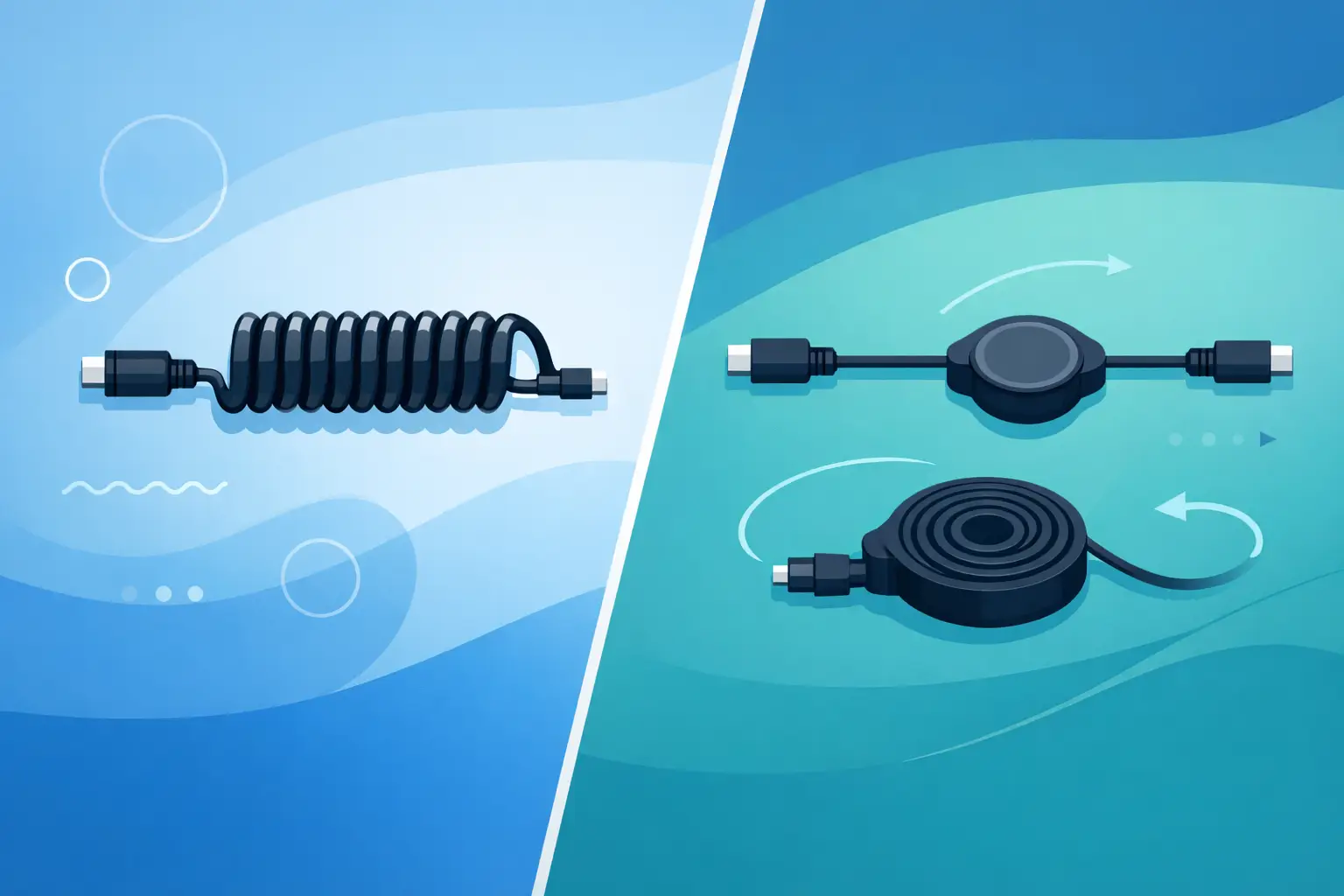

If a cord needs to stretch, recover, and keep equipment connections controlled, the difference between coiled and retractile cords matters early in the design process. These two terms are often used interchangeably in casual sourcing conversations, but they do not always describe the same construction, performance range, or application fit. For OEM teams and industrial buyers, that distinction affects durability, cable management, user handling, and long-term field performance.
In practice, both cord types help reduce slack and keep work areas cleaner than straight cable. Both can support motion, repeated extension, and compact routing where extra cable length would otherwise create handling problems. The key issue is not whether one is universally better. It is whether the cord’s construction matches the mechanical demands of the equipment and the environment where it will be used.
What is the difference between coiled and retractile cords?
The simplest way to define the difference between coiled and retractile cords is this: a coiled cord refers to a cable formed into a spiral shape, while a retractile cord is designed specifically to extend and then actively return toward its original coiled length after release.
That may sound like a minor wording issue, but it matters. A cord can be coiled without delivering the level of extension, memory, and recovery expected from a true retractile design. In many industrial and commercial settings, buyers use the term coiled as a broad category and retractile as the more performance-specific subset.
A basic coiled cord may be selected primarily for space savings, appearance, or moderate extension. A retractile cord is usually specified when extension and pull-back behavior are functional requirements. That means the material formulation, coil geometry, wall thickness, conductor design, and manufacturing process carry more weight.
In other words, all retractile cords are coiled in form, but not every coiled cord should be treated as a retractile cord from a performance standpoint.
Construction differences that affect performance
For engineering and sourcing teams, the distinction becomes clearer when looking at how the cord is built.
A coiled cord is typically formed by taking cable and processing it into a spiral shape. Depending on the design, it may offer limited or moderate extension and some natural tendency to contract. However, the coil itself may be more about cable organization than repeatable dynamic performance.
A retractile cord is engineered around controlled elongation and recovery. The base cable material, coil diameter, pitch, retraction force, and extended working length are selected to support repeated stretching without excessive deformation. If the cord is expected to cycle frequently in use, the retractile behavior cannot be an afterthought.
This is where buyers can run into trouble. Two products may look similar in a catalog photo, but one may be suitable for intermittent hand-tool movement while the other is intended for lighter-duty, lower-cycle use. Visual appearance does not tell the whole story.
Jacket material also plays a major role. Different compounds affect flexibility, memory retention, abrasion resistance, temperature tolerance, and chemical exposure. A cord used near medical equipment, food service devices, manufacturing tools, or warehouse systems may face very different conditions. The more demanding the environment, the less useful a generic “coiled cord” label becomes.
Why buyers often confuse the terms
The market itself contributes to the confusion. In some product categories, coiled and retractile are used as near-synonyms. In others, retractile signals a more engineered product with defined extension and recovery characteristics.
That overlap is common in everyday buying language, but it can create specification gaps. A purchasing team may request a coiled cord, expecting strong pull-back and a specific extended working length. A supplier may interpret that as a standard spiral cord unless the application details are clearly stated.
This is why application-based specification matters more than label-based ordering. If the cord needs to maintain tension, avoid drooping, recover consistently, or tolerate repeated motion, those requirements should be stated directly. The product name alone is not enough.
How the difference between coiled and retractile cords shows up in use
The most practical way to evaluate the difference between coiled and retractile cords is to look at what the cord must do during real operation.
In a light-duty application, a coiled cord may be perfectly adequate. If the purpose is simply to keep excess cable contained behind equipment or to allow occasional extension without leaving loose cable on a bench or cart, a standard coiled construction may meet the need at a lower cost.
In a dynamic-use application, retractile performance becomes more important. Handheld devices, movable accessories, service tools, and operator-facing equipment often require a cord that extends predictably and retracts with enough force to stay out of the way. If the cord hangs excessively after repeated use, the original cable-management benefit starts to disappear.
There is also a trade-off. Stronger retraction can improve cable control, but too much pull force may create user resistance, connector stress, or handling fatigue. A retractile cord should not be selected based on maximum recovery alone. It needs the right balance between reach and return.
Key specification questions before sourcing
When comparing options, buyers should start with the equipment motion and user interaction rather than the cord name.
The first question is how much extension is actually needed in operation. Not just the maximum possible stretch, but the normal working length and the peak length under real use. A cord that is stretched too close to its limit on every cycle will generally have a shorter useful life.
The second question is cycle demand. An application with occasional adjustment is very different from one where the cord extends and retracts throughout the day. Frequent cycling raises the importance of conductor stranding, jacket resilience, and coil memory.
The third question is environmental exposure. Heat, oils, cleaning agents, abrasion, sharp edges, and UV exposure can all change material suitability. A cord that performs well in an office-adjacent device may not hold up in food equipment, industrial tools, or lab systems.
The fourth question is electrical and regulatory fit. Voltage, current, conductor count, shielding needs, plug configuration, and applicable approvals should be settled alongside the mechanical requirements. The cord has to function electrically and mechanically as one system.
When a coiled cord is the better choice
A coiled cord is often the better fit when compact routing is the main goal and the extension demands are moderate. This can apply to equipment where cable control matters, but active retraction performance is not highly critical.
It may also be the right choice when the movement path is predictable and limited, or when the budget does not support a more engineered retractile solution. In these cases, a simpler coiled design can still improve workspace organization and reduce cable clutter.
That said, cost savings only help if the cord remains suitable in service. If users begin overextending it or if the coil loses shape quickly, the lower initial cost can lead to replacement, downtime, or complaints in the field.
When a retractile cord is the better choice
A retractile cord is usually the better option when extension and recovery are part of the product’s normal function. This is common in handheld connected devices, movable components, test equipment, communication accessories, and industrial systems where cable slack must be controlled consistently.
It also makes sense when the product experience depends on the cord staying compact after use. In many OEM applications, the cord is not just an electrical component. It influences usability, safety, and the appearance of the finished equipment.
For custom or specification-driven programs, retractile cords often require closer review of working length, coil set, end lengths, termination style, and expected duty cycle. That extra front-end definition usually pays off by reducing ambiguity later in production.
A practical sourcing view
For most B2B buyers, the decision should not start with terminology alone. It should start with use conditions, extension range, retraction expectations, electrical requirements, and service life targets. Once those are clear, the right cord type becomes easier to define.
This is also where an experienced supplier adds value. A sourcing conversation should clarify whether the application calls for a general coiled form or true retractile performance, and whether a standard part can meet the requirement or a custom approach makes more sense. High Tech Connections works with buyers who need that kind of specification-driven support across standard and custom cord requirements.
A useful rule is simple: if the coil is mainly there to keep cable neat, a coiled cord may be enough. If the cord must repeatedly extend and return in a controlled way, treat it as a retractile application and specify it accordingly.
The right choice is rarely about terminology. It is about making sure the cord behaves the way your equipment and users expect after the hundredth pull, not just the first.
Leave a Comment