
Coiled Cords vs Straight Cables
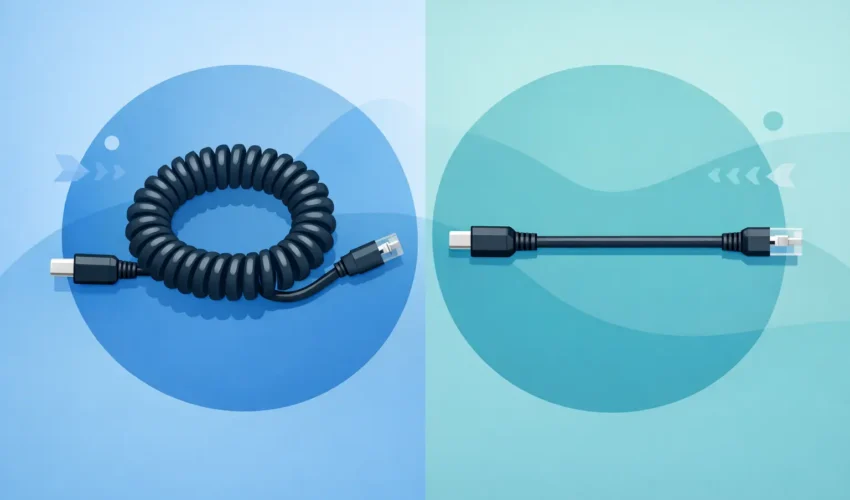

A cable that drags across a work surface, catches on a cart, or stretches past its intended length usually becomes a problem long before it becomes a failure. That is why coiled cords vs straight cables is not just a packaging or appearance decision. For OEMs, equipment builders, and industrial buyers, the right choice affects cable life, operator movement, storage, serviceability, and the overall fit of a finished product.
In many applications, both options can work. The better choice depends on how the equipment moves, how often the cord is handled, how much slack is acceptable, and what the operating environment demands. A cord on a handheld control pendant has different priorities than a cord on a benchtop instrument or a fixed server installation.
Coiled cords vs straight cables: the practical difference
A straight cable keeps a fixed overall length and follows the most direct routing path available. It is typically the better fit when the connection points are stable, the cable run is predictable, and extra tension is not desirable. In stationary equipment, that simplicity is often an advantage.
A coiled cord, sometimes specified as a retractile cord, is designed to extend and then return toward a shorter resting length. That makes it useful where movement is expected but loose cable needs to be controlled. Instead of leaving excess length on the floor, table, or enclosure edge, the coil manages the slack.
This sounds straightforward, but the design trade-offs matter. A coiled cord adds retraction force, a different bend profile, and more variables around extension limits. A straight cable avoids those issues, but it may require strain relief planning, clips, guides, or more installation space to manage unused length.
When coiled cords make more sense
Coiled cords are usually chosen for dynamic applications where a user, tool, or accessory needs variable reach within a defined range. Common examples include handheld devices, medical carts, communication handsets, test equipment, light-duty industrial controls, and mobile accessories connected to fixed power or signal points.
The main benefit is cable management during use. A coiled cord reduces trailing slack, which can help limit snagging, abrasion, and clutter. In environments where operators repeatedly extend and release a cord, that self-managing behavior is often more practical than relying on a long straight cable.
They can also support a cleaner product design. For OEMs, the visual and functional benefit is real when the cord needs to stay compact most of the time but still provide occasional reach. A coiled assembly can help reduce the impression of excess cable while keeping the connection available.
That said, coiled cords are not automatically the better choice for moving applications. The expected extension length, frequency of use, and pull direction all matter. If the cord will be stretched close to its maximum length for long periods, the retractile design may work against the application rather than support it.
Performance factors to check on coiled designs
The first issue is working extension. A coiled cord should be specified around normal operating length, not just maximum possible stretch. If users regularly pull the cord to its limit, conductor stress and long-term fatigue become more likely.
The second is retraction force. That force helps control slack, but too much of it can create user annoyance, connector loading, or unwanted pull on lightweight equipment. This is especially relevant in medical devices, desktop equipment, and handheld accessories where connector stability matters.
The third is environmental fit. Temperature, chemical exposure, cleaning cycles, and flex frequency all influence jacket and conductor performance. A coiled cord intended for light commercial use may not hold up the same way in a plant, lab, or washdown-adjacent setting.
Where straight cables are the better fit
Straight cables are usually the right choice when the cable path is known and stable. If a power cord runs from a machine enclosure to an outlet, from a desktop power supply to equipment, or within a fixed installation where movement is minimal, a straight configuration is often simpler and more durable in practice.
They are also easier to specify for exact length. That matters in assemblies where excess cable creates airflow issues, service access problems, or poor cable routing inside a product or workstation. A straight cable gives engineering and production teams a more predictable physical layout.
In many industrial and commercial applications, straight cables also place less ongoing mechanical demand on the connection. There is no constant retractile force pulling back toward a resting shape. For equipment that remains connected for long periods, that can be an advantage for connector seating and strain relief management.
Straight cables tend to be the lower-complexity option as well. For many buyers, that translates to easier sourcing, more standard configurations, and fewer application-specific performance questions. When the use case does not truly benefit from retraction, a straight cable may be the more efficient purchasing decision.
Cases where straight cables avoid common problems
If operators need full-time reach rather than occasional reach, a straight cable often performs better. A coiled cord kept in a stretched state loses much of its functional benefit and may introduce unnecessary tension.
If the cable carries more weight due to conductor count, shielding, or jacket construction, a straight design may also be more practical. Heavier cable constructions can be less suitable for retractile formats, depending on size, flexibility, and use conditions.
And if the product is installed in a tight, controlled space, straight lengths can simplify inventory and production. A specified cable length with defined ends is often easier to route consistently than a coil with variable resting behavior.
Cost, durability, and sourcing considerations
Buyers often start with price, but total application cost is the better measure. A straight cable may have a lower unit cost, yet require more cable management hardware or more service attention if excess slack causes wear. A coiled cord may cost more upfront, but reduce handling issues in the field.
Durability also depends on use pattern, not just cable type. Coiled cords are built for repeated extension and recovery, but only within the right operating range. Straight cables may last longer in static applications simply because they are not being continuously flexed or tensioned.
From a sourcing perspective, straight cables are generally easier to standardize across multiple product lines when routing conditions are similar. Coiled cords often need more detailed review of retracted length, extended length, coil diameter, conductor construction, jacket material, and end termination requirements.
For OEM and ODM teams, that means the best choice often comes down to specification discipline. If the application is dynamic and cable control is valuable, it makes sense to invest in a properly engineered coiled design. If the product environment is fixed and predictable, the simpler straight configuration may deliver better long-term value.
How to choose between coiled cords and straight cables
The most useful starting point is not cable style but actual equipment behavior. Ask how the cable will be used during a normal shift, service event, or installation cycle. Is the connection mostly stationary, or is it extended and released repeatedly? Does loose cable create a real hazard or nuisance, or is it easily managed through routing?
Next, look at the consequences of tension. Some products can tolerate moderate pullback force without issue. Others cannot. Lightweight equipment, sensitive connectors, and devices used in precise positioning applications may not respond well to a cord that is always trying to retract.
Then consider environment and compliance expectations. Industrial, medical, laboratory, and commercial applications often place different demands on flexibility, jacket material, cleaning resistance, bend life, and approvals. The right cord is not just the one that reaches. It is the one that performs consistently under the actual use conditions.
This is also where supplier support matters. A specification-driven supplier can help evaluate whether a standard product is sufficient or whether a custom retractile or straight assembly is the better fit. High Tech Connections supports buyers who need that kind of practical sourcing input, especially when application details affect long-term field performance.
The better option is the one that fits the job
There is no universal winner in coiled cords vs straight cables. Coiled cords are valuable when variable reach and slack control are part of the design requirement. Straight cables are often better when stability, exact length, and low mechanical tension matter more.
For engineering and procurement teams, the right decision usually comes from matching cable behavior to equipment behavior. If the cord has to move, manage itself, and stay out of the way, a coiled design may be the smarter choice. If it needs to stay predictable, route cleanly, and hold up in a fixed installation, a straight cable is often the better answer. A few minutes spent reviewing movement, reach, and operating conditions up front can prevent a much larger problem after production starts.
Leave a Comment