
Choosing Power Connectivity Components for Manufacturers
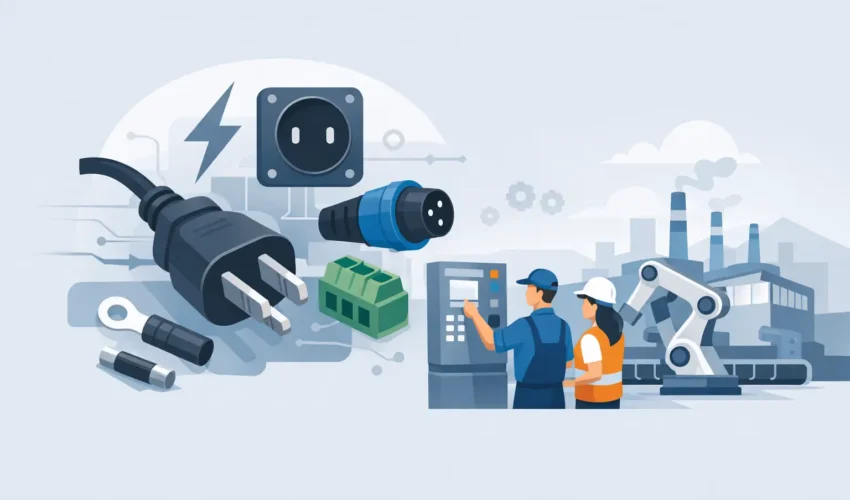

A power supply issue rarely starts with the power supply alone. More often, it shows up as a failed field installation, an adapter that runs too hot, a cord set that does not match the end market, or a sourcing delay that holds up production. That is why power connectivity components for manufacturers need to be selected as part of the product design and procurement strategy, not treated as an afterthought.
For OEMs, ODMs, and industrial equipment builders, the right component choice affects more than electrical performance. It affects compliance, assembly efficiency, replacement cycles, serviceability, and the ability to ship into the markets your equipment is meant to serve. A cord, plug, inlet, adapter, or coiled assembly may look straightforward on paper, but in practice, small specification gaps can create expensive downstream problems.
Why power connectivity components for manufacturers deserve early attention
Engineering teams usually focus first on the main equipment functions. Procurement teams focus on continuity, cost, and lead time. Both are right to do so. The challenge is that power connectivity sits between those priorities, and when it is not addressed early, compromises tend to surface late.
A power cord that meets voltage and current requirements may still be the wrong fit if it lacks the proper approvals for the target market. An AC adapter may deliver the required output but still create thermal or mounting issues in the finished product. A retractile cord may solve space constraints but add mechanical considerations that a straight cord does not.
Early specification work gives manufacturers room to evaluate what actually matters for the application. That includes connector type, cord construction, jacket material, bend requirements, current rating, environmental exposure, and the practical realities of sourcing at production scale. When these decisions are delayed, teams often end up buying for immediate compatibility instead of long-term fit.
The main component categories and where selection gets difficult
Most equipment manufacturers work across a familiar set of power connection categories, but each has its own decision points.
Power cords and cord sets
For many products, the power cord is the most visible and most frequently handled electrical component. It needs to match the equipment inlet, support the intended current load, and meet the regulatory expectations of the destination market. Domestic and international configurations matter here. A product designed for North America may require a very different cord strategy than one intended for global distribution.
The difficult part is that cord selection is not just about plug pattern. Flexibility, jacket durability, conductor size, temperature rating, and overall length all affect usability and product performance. In some applications, a standard cord set is the right answer. In others, custom lengths or specific jacket materials are necessary to avoid installation or wear problems.
AC/DC adapters and desktop power supplies
External power supplies can simplify internal equipment design, but only if the electrical and physical requirements are fully aligned. Output voltage and current are only the starting point. Connector dimensions, polarity, efficiency expectations, operating temperature, and end-use approvals all need to line up with the equipment.
There is also a trade-off between standardization and exact fit. A widely available adapter may reduce sourcing complexity, but it may not provide the ideal cord length, enclosure style, or performance margin for the application. For regulated or performance-sensitive equipment, that trade-off needs careful review.
Coiled and retractile cords
These products are often chosen for space management, mobility, or repeated extension and retraction. They are common in industrial tools, communications equipment, medical devices, and installed systems where straight cords would create handling problems.
The specification challenge is mechanical as much as electrical. Coil memory, retraction force, extension length, conductor design, and environmental exposure all influence service life. A coiled cord that works well in one setting may be a poor choice in another if it is exposed to sharp movement, chemicals, or continuous tension.
What engineering and purchasing teams should evaluate first
The best sourcing outcomes usually come from starting with the non-negotiables. For power connectivity components, those are application fit, compliance, and supply practicality.
Application fit means understanding how the component will be used in real operating conditions. Will the equipment be stationary or mobile? Is it used indoors, outdoors, or near heat, moisture, vibration, or cleaning agents? Does the cord need to route through tight spaces or bend frequently? Those conditions narrow the field quickly.
Compliance comes next because it cannot be patched in later without cost. If the finished equipment serves medical, laboratory, food service, industrial, or technical markets, power components need to align with the approvals and performance expectations that apply to those environments. The wrong selection can create redesign work, recertification issues, or shipment delays.
Supply practicality is where many otherwise acceptable parts fall out. A component may look right from a technical standpoint but become a problem if lead times are unstable, sampling is limited, or sourcing options are too narrow. Manufacturers need power components that can support both qualification and ongoing production, not just initial prototypes.
Standard product or custom solution
This is one of the most common sourcing questions, and the answer depends on volume, application, and risk tolerance.
Standard products are often the fastest route when the application is straightforward and the specification fits available configurations. They can reduce qualification time and simplify replenishment. For many equipment programs, this is the most efficient path.
Custom sourcing becomes more attractive when standard options create compromises. That might involve a nonstandard cord length, a specific plug or connector combination, a different jacket material, or an assembly tailored to the equipment enclosure. Customization can improve fit and reduce installation issues, but it usually requires more coordination around sampling, documentation, and production planning.
The practical question is not whether custom is better. It is whether the application justifies the added complexity. In some cases, a standard component with minor design accommodation is the smarter commercial decision. In others, the cost of forcing a standard part into the wrong use case is much higher over time.
Common mistakes in sourcing power connectivity components for manufacturers
One common mistake is specifying only the electrical rating and assuming the rest will sort itself out. Electrical compatibility is necessary, but it does not address handling, durability, approvals, or installation realities.
Another is treating cords and adapters as low-risk commodities across all product lines. Some are. Many are not. When equipment operates in regulated, high-use, or performance-sensitive environments, a seemingly basic power component can become a critical quality variable.
A third mistake is separating engineering review from procurement planning. If engineering selects a part with limited sourcing flexibility, purchasing inherits the risk. If purchasing substitutes based on cost alone, engineering may inherit a performance or compliance problem. Better outcomes come when both groups work from the same application requirements and supply assumptions.
What a dependable supply partner should actually help with
Manufacturers do not just need a catalog. They need a source that can help confirm fit, identify options, support sampling, and align product availability with production needs. That is especially true when equipment programs include multiple models, evolving specifications, or international market requirements.
A dependable supplier should be able to speak clearly about standard versus custom paths, help narrow product choices based on real application details, and support teams that need both technical clarity and purchasing responsiveness. Breadth matters, but so does the ability to reduce back-and-forth during qualification.
This is where experience has practical value. A supplier that works regularly with OEM and industrial buyers has usually seen the same failure points before – mismatched approvals, connector confusion, inadequate cord construction, or avoidable delays caused by narrow sourcing assumptions. High Tech Connections serves that role by focusing on specification-driven power products and helping manufacturers move from requirement to usable sourcing decision with less friction.
Better decisions start with the use case
There is no single best choice across all power connectivity categories. The right component depends on where the equipment is used, how it is serviced, what standards it must meet, and how reliably it needs to be sourced over time. That is why the strongest decisions are usually the least generic.
If a component will sit inside a tightly controlled commercial environment, the answer may be different than it would be for a mobile device in a demanding industrial setting. If the product line is stable and high-volume, standardization may offer clear advantages. If the program is specialized, custom sourcing may prevent recurring fit and field issues.
When manufacturers treat power connectivity as a specification decision instead of a line-item purchase, they tend to get better outcomes across engineering, operations, and service. That is usually where the real savings show up – not in the initial unit price, but in fewer surprises after the product is built.
Leave a Comment